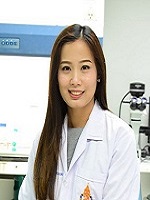
Asst.Prof.Dr. Pasarat Khongkow


- Details
- Category: Uncategorised
- Published on Tuesday, 25 October 2022 17:31
- Written by Super User
- Hits: 1767
Asst. Prof. Dr. Pasarat Khongkow
Director of Translational Medicine Research Center, Faculty of Medicine, Prince of Songkla University
Senior Lecturer at Department of Biomedical Sciences and Biomedical Engineering, Faculty of Medicine, Prince of Songkla University
King Mongkut’s University of Technology Thonburi
Abstract
Precision Medicine is an advanced approach to select the right treatments to the right patients at the right time by screening for molecular tumour alterations that predict treatment response, ideally leading to optimal treatments for cancer patients. Recently, functional assays by integrating patient-derived organoid (PDO) and microfluidic technology has been represented as an alternative and innovative tool to directly evaluate and predict treatment efficacy from the patient’s cells. In this work, we highlight our optimal and cost-effective methods for generating prostate and breast cancer organoids within 4 weeks, as well as a new approach todesign and fabricate an optimized cancer-on-a-chip platform, as novel tools for predicting patients’ responses and enabling physicians to select treatments that potentially improve treatment outcomes of cancer patients.
Biography
Asst.Prof. Dr. Pasarat completed her Ph.D. in Molecular Oncology from Imperial College London, UK in 2015. She has joined Department of Biomedical Science and Biomedical Engineering, the Faculty of Medicine, Prince of Songkla University since 2016. Now, she is a director of Translational Medicine Research Center, Faculty of Medicine. Her current research is focused on Cancer Precision Medicine by elucidating of cellular signalling mechanisms associated with tumorigenesis, DNA damage response, metastasis and chemotherapy resistance in breast cancer, as well as the identification of novel cancer biomarkers and effective targeted cancer therapies using advance cellular and molecular bioengineering technologies. She is also interested in developing innovative research tools for cancer precision medicine research and drug discovery. More physiological 3D cell culture systems, cancer organoid culture, cell-on-chip technology, live cell imaging, and advanced genetic engineering are key study points. In addition to cancer research, she also develops the innovative cell-based systems for skincare efficacy testing and anti-Alzheimer’s